
By Jumah Kakomo
Civil Society Organizations (CSOs) are set to petition president Yoweri Kaguta Tibuhaburwa Museveni urging him to re-think the government’s position on Bugoma Central Forest Reserve (CFR) give away to land grab.

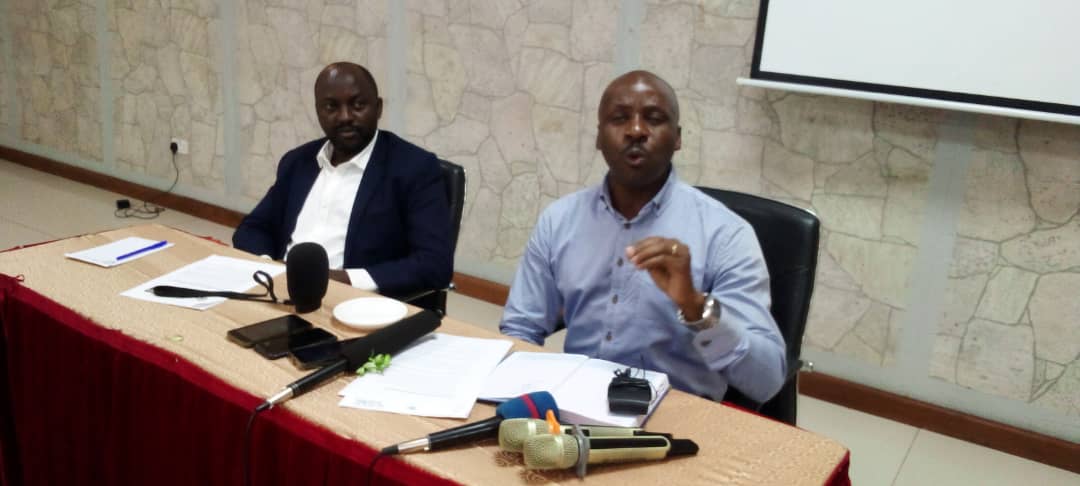
Dickens Kamugisha, the chief executive officer (CEO) Africa Institute for energy governance (AFRICO), while addressing the press on Friday said the move is part of “Save Bugoma Forest Campaign (SBFC) whose objective is to defend Bugoma CFR from land grabbing for sugarcane growing and oil threats.
He noted that on November 30, 2023, the minister of Lands, Housing and Urban Development (MLHUD) forwarded the Bugoma CFR survey report to the minister of water and environment (MWE). The report was prepared by the department of surveys and mappings, as directed by cabinet sometime in 2019, under cabinet No.465 (CT2019. The directive included the task of opening the boundaries of Bugoma CFR to determine whether Hoima sugar limited (HSL) encroached on the forest land and to resolve other pending boundary verification exercises ordered by the court to ensure the conservation of the forest.
Kamugisha said “as civil society partners under SBFC, we are dismayed with the report since it doesn’t provide a definitive finding on whether HSL encroached on Bugoma CFR land, it relies on the illegally obtained certificates of registration, the illegal environment social impact assessment (ESIA) certificate, the search statement, and court judgments to reach a finding that Hoima Sugar Ltd is utilizing land leased to it by the Omukama of Bunyoro Kitara Kingdom, without determining whether that land is within the Bugoma CFR gazette area.”
He added that “While we appreciate the exercise, we note that it falls short of expectations and does not solve the issue at hand. Rather, it seeks to validate the illegal land grab under the guise of Bugoma CFR. The government’s failure to definitively address the encroachment issue is concerning. We urge a thorough investigation to ensure the conservation of Bugoma CFR”
CSOs assert that Bugoma forest is vital to the environment, and any attempt to encroach upon it must be stopped to protect the ecosystem.

Kamugisha further highlighted 10 recommendations to the government and the relevant bodies to address the gaps in the survey and boundary open report as measures to save Bugoma forest which include;
1. Urgently address the gaps in the survey and boundary opening report. The government should urgently address the gaps in the survey and make positive recommendations for the conservation of Bugoma CFR land.
2. Avail a conclusive finding of Hoima sugarcane Limited’s encroachment: Task surveyors to make a conclusive finding as per the terms of reference regarding Hoima Sugar’s encroachment on Bugoma CFR.
3. Cancel all the illegal titles: Cancel all illegal and fraudulent land titles in forested and protected reserves.
4. Verify the Bugoma CFR area: The boundary survey report must show whether the forest land still exists and, if not, where part of the forest land is.
5. Preserve Bugoma forest habitat: Preserve Bugoma forest as it is, and do not use boundary exercise as excuses for cutting parts of the rain tropical forest.
6. Stop intimidating environmental activities: Stop intimidating activists challenging the illegal giveaway of forest land with trumped up charges to silence them.
7. Tackle corruption: Corruption hindering conservation efforts should be tackled, especially prosecuting those issuing illegal certificates in forest lands without Parliamentary de-gazetting.
8. Reconsidering of forest management: Reconsider the management of forests in Uganda, particularly in light, the pending merger of ministries departments and agencies (MDAs). In addition, the government should strengthen the institutional capacity of the NFA to manage all forests.
10. The survey and boundary opening report must also indicate whether the entire over 41,000 hectares of Bugoma CFR land is still intact or not.

Godfrey Twesigye, a team leader of water and environment media network Uganda (WEMNET) said some encroachers claim the land was granted to them by the Bunyoro Kitara Kingdom, while others assert ownership with land titles.
The most affected areas include Ngogoli, Kasenta, Nyairongo, and Mandwiga in Kyangwali and Kabwoya sub-counties in Kikuube district.
Expressing concern over the potential impact of climate change due to the continuous depletion of Bugoma Forest, Twesigye emphasized the significance of preserving natural forests.
He says he is surprised to learn that RDCs, Police have greatly contributed a lot to fight people who also fight to save Bugoma forest.
He adds that many people have been awarded hectares of forest’s land pointing out Hoima sugarcane Limited among others thus urged the government to consider their concerns and take appropriate action to protect Bugoma CFR and other critical forest reserves in Uganda.
Over 8,000 hectares, out of the total 41,000 hectares of Bugoma Forest, have been affected by encroachment, according to a statement by National Forestry Authority (NFA) Kisindi sector manager, Alex Obonyo, January 31, 2024.
“We have contacted various people concerned regarding the matter, but they have kept on paying deaf ears without taking any actions as the forest continues to get destroyed, but let us fight together as Ugandans to save Bugoma forest as well as protecting our environment” Twesiggye said.
Brief notes about Bugoma forest.
Bugoma Forest, is a protected tropical forest, located in the Hoima district of western Uganda. It lies southwest of Hoima, northeast of Kyenjojo towns, and east of Lake Albert.
The forest was gazetted in 1932 and came under the mandate of the National Forestry Authority in 2003. The forest is estimated to have over 41,000 hectares of land. Bugoma Forest is part of a belt of extensive, lowland forests along Uganda’s western rift escarpment. It is situated at elevations between 990 and 1,300 meters above sea level. The forest receives regional rainfall ranging from 1,250 to 1,625 mm. The tree cover varies, with early colonizing forest species giving way to climax forest communities at different altitudes.
Name Origin: The name “Bugoma” means “small drum.” Historically, the Omukama Kabalega used to train the royal army of Bunyoro (Abarusura) in the trees of Budongo’s royal mile, which he planted himself. Some tree species in Bugoma, such as “Mwitansowera” (loosely translated as “Killer of House insects”), are believed to have supernatural powers and are never logged or touched by anyone.
Wildlife: Bugoma Forest is home to diverse wildlife, including 23 species of mammals, 225 species of birds (including Nahan’s Francolin and Grey Parrots), butterfly species, and 260 plant species.
