
By Elijah Khisa
Under the guidance of Mr. Twesiime Brighton, the club’s participation in the eighth Uganda National Science Olympiad has proven to be a steppingstone in providing learners with more than an opportunity to compete on the national stages.
As we speak, Namilyango College is strengthening its culture of scientific inquiry, research, and innovation, with the Science & Technology Club recording most of the notable achievements in the 2026 Uganda National Science Olympiad (UNSO).
The competition has created a practical platform for students to research, present ideas, defend scientific arguments and evaluate their problem-solving abilities beyond the classroom. For Namilyango College, the journey seems to be producing more than several milestones that point to growing interest and capability in science-based learning.
The 2026 competition, organized by the Science Olympiad Foundation Uganda (SOFU), saw hundreds of secondary school learners from across the country compete in scientific research, innovation and other developments.
Which Three Teams Were Recognized Among Top Research Teams?
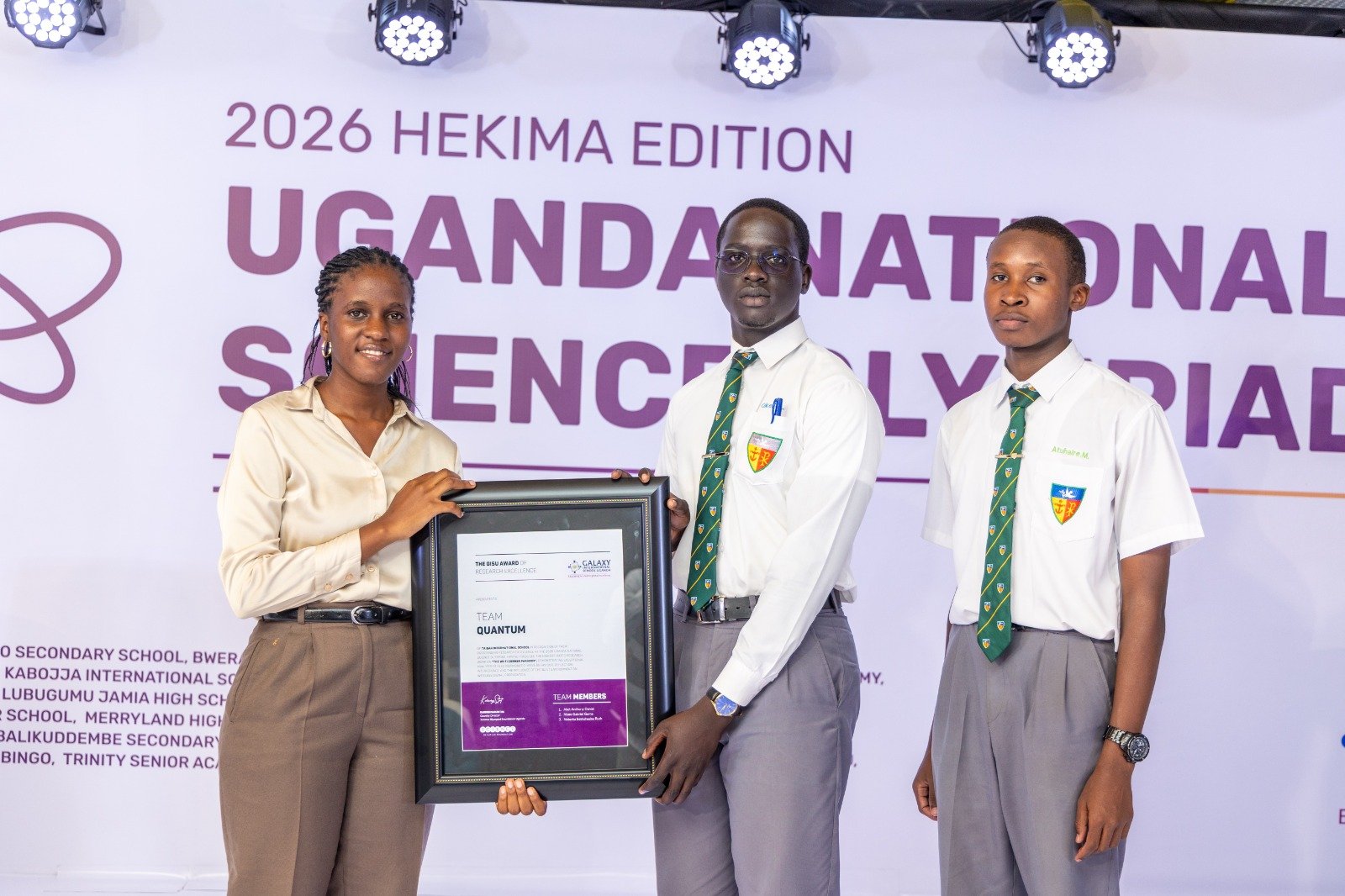
One of the clearest highlights came during the research phase, the first stage of the Uganda National Science Olympiad as three Namilyango College teams emerged among the Top Research Teams in their respective categories: Safety Mavericks-Fermentation in the Biology field gunning 55.0, Super Nova-Ugali Hardening in the Chemistry field gunning 54 and Team Newton-The Motorcycle Headlamp in the Physics field gunning -55.0.
The teams were set to receive recognition for their performance in Biology, Chemistry and Physics, respectively as their results also demonstrated the learners’ ability to engage with scientific research beyond conventional classroom exercises.
These projects illustrated an important aspect of science in education, scientific thinking and where it could begin with everyday questions to challenge societal developments and changes.
From food fermentation and the behavior of ugali to the science behind a motorcycle headlamp, the learners explored subjects connected to experiences that are familiar within their communities.
What Eight Teams Took Namilyango College to the National Round?
The research success was indeed successful as it swung another significant milestone for the Eight Namilyango College teams to qualifying for the National Round of the 2026 Uganda National Science Olympiad. Among the teams that qualified were:
• Mavericks
• Team Newton
• Supernova
• Prodigies
• Higgs Bossons
• Dark Side
• Aristotles
• The Bosonites
The breadth of the qualification is significant because it demonstrated participation across multiple teams rather than relying on a distinct group of learners.
For the Science & Technology Club, this created an important foundation for developing a sustained pipeline of young researchers who can participate in scientific competitions at dissimilar stages of their secondary education.
From Research to The Science Fight- How did they Make it through?
The National Round introduced learners to a different kind of scientific challenge, one much tighter and tougher as the competition adopted a Science Fight format designed to closely resemble a real-world PhD defense.
The notion was, instead of simply presenting their work, teams were expected to explain their scientific ideas, defend their research and respond to questions and indeed Namilyango College under the coaching of Muhanguzi Solomon as its main specialized trainer for the National Round, happened to cruise through the challenge seamlessly.

Meanwhile, the format placed communication alongside scientific knowledge for learners to understand that science was only part of the challenge and that they also had to demonstrate confidence, clarity, reasoning, and the ability to respond to scrutiny.
That experience had value well beyond a competition and these are the same skills learners could use later in university research, professional presentations, innovation challenges, and scientific careers.
Jubilations only-Team Mavericks Finish Sixth Out of 87.
Jubilations as Namilyango College’s strongest team, the “Mavericks” turned out to be the best with an overall position in the National Round of sixth out of 87 competing teams. The team comprised of: Ssali Jean-S.6, Kateega Arthur -S.6, and Wampamba Jordan-S.6.
Finishing sixth among 87 competing teams provided one of the strongest competitive highlights of Namilyango College’s 2026 participation.
The result also offered a useful reference point for the club as it prepares future teams: there is already evidence that Namilyango learners can compete strongly at national level when research, preparation and teamwork come together.
Individual Learners Also Make Their Mark-Meet The Best Learners.
The achievements extended beyond team rankings. Kateega Arthur, an S.6 learner and member of Team Mavericks, received an accolade after being recognized by the school as the best under the opponents category during the tournament.
Younger learners also demonstrated promising potential.
Kyarimpa Raphael, an S.3 learner, ranked seventh out of 87 in the role he played during the tournament, while Jeremiah Owens Ayinza, an S.3.C learner, ranked sixth out of 87 in his respective role.
Their performances are particularly noteworthy because they show that scientific competition is not limited to senior students. Early exposure can give younger learners opportunities to develop confidence, scientific reasoning, and competitive experience.
A Question for the Next Generation-Are You Ready?
What could happen if more S.1, S.2, and S.3 learners begin engaging with scientific research early? The 2026 experience suggests that introducing learners to research and scientific competition earlier can help build a stronger pipeline of talent for future national and international opportunities.
Beyond the Classroom: What else is the Science Olympiad Building?
The value of the Science & Technology Club’s participation goes beyond medals, rankings, and certificates: The experience has given learners opportunities to:
• Research:Students investigated scientific questions through the research phase.
• Communicate: The Science Fight required learners to explain complex ideas clearly.
• Defend ideas: Participants had to respond to questions about their scientific work.
• Collaborate: Team-based competition required learners to work together under pressure.
• Think critically: Scientific arguments had to withstand questioning and examination.
The Competition specifically identifies opportunities for learners to apply scientific knowledge beyond the classroom while developing research, presentation, analytical and critical thinking skills.
The Challenges-Turning Participation Into Sustainable Growth
The 2026 experience also points to areas that require continued investment. The school’s recommendations call for stronger mentorship in scientific writing, presentation and defense, alongside continued participation in future Uganda National Science Olympiad competitions.
This is important because scientific excellence requires more than producing good research once. Learners need consistent mentorship to improve how they formulate questions, document findings, communicate evidence and defend conclusions.
The postponement of the 2026 National Round due to the Ebola Virus Disease outbreak also introduced an unexpected disruption to the competition calendar before the rescheduled event.
Rather than defining the experience by the disruption, the eventual participation demonstrates the importance of adaptability in academic programmes and competitions.
What is next? From National Competition to International Opportunity.
The next opportunity could take Namilyango College’s science journey beyond Uganda. According to the report, schools and teams that qualified for and participated in the 2026 National Round are eligible to express interest in representing Uganda at selected 2027 International Rounds.
The opportunities include:
• Hellenic Young Naturalists Tournament-Greece
• April 2027 | Up to 18 years | 3 team slots
• International Young Naturalists Tournament-China
• July 2027 | Up to 16 years | 3 team slots
• International Young Physicists’ Tournament-New Zealand
• July 2027 | No age limit | 1 team slot
These international competitions provide a potential progression from national scientific competition to international scientific engagement. For Namilyango College learners, the opportunity raises a bigger question: how can today’s research experience become tomorrow’s international scientific contribution?
Brighton Tusiime and the Next Chapter for the Club.
The 2026 Science Olympiad journey places renewed attention on the role of structured mentorship in developing scientific talent.
As patron, Mr. Twesiime Brighton acknowledged the contribution of the school administration, Science Department, patrons, teachers, trainers, and learners throughout the competition.
He hopes that the next chapter would present an opportunity to build on what has already been achieved, strengthen mentorship, encourage scientific writing and presentation, support younger learners, and create pathways for promising students to pursue international opportunities. “I strongly believe in the young minds of the students, and would really wish to see many of this type of competitions developing within the country”
What this Means for Namilyango College.
The 2026 Uganda National Science Olympiad has provided the Science & Technology Club with measurable evidence of progress.
Three teams were recognized among the Top Research Teams, Eight teams qualified for the National Round, Team Mavericks finished sixth out of 87 teams, Individual learners received notable recognition and rankings.
And the participating teams now have a potential pathway towards international science competitions in 2027. These milestones provide a foundation, but they are not the destination.
The greater opportunity lies in turning competition participation into a sustained culture of research, innovation, scientific communication, and problem-solving across the value chain systems.
