
By Kabuye Ronald
On a chilly Sunday afternoon, 37-year-old Ruth Asiimwe is happily tending to her pigs together with her young children when I pay her a visit and request an interview.
After offering me a glass of cold water, she jokingly says “we can now afford to take some chilled water and fruits because we managed to buy a refrigerator and can now afford power bills,” as she takes a seat next to me.
Asiimwe is a beneficiary of a poverty eradication project that was started by a church in her locality. She calls it the “start with 3” project.

She is a single mother of two and a resident of Sonde village, Namugongo Division, Kira municipality who also cares for her ailing grandmother.
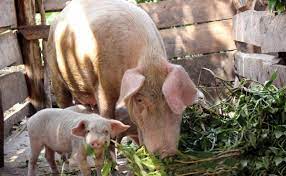
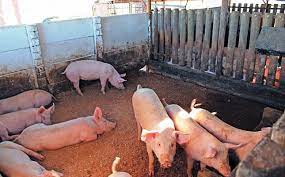
Asiimwe started with only three piglets that were provided through her church but she proudly presents a filled shelter of animals that are visibly well-fed and clean. At first glance, it is evident that this is a serious farming project right in the heart of the city. She is engaged in urban farming.
“Poverty is a hungry lion and if you don’t run so fast, you will die,” she throws a commonly used Kiganda proverb to refer to how dangerous lacking economic empowerment can be.
Over the past three decades, Uganda’s national poverty rate has fallen by more than half, from 56% in 1992/1993 to 21.4% in 2019/2020, owing mostly to improved agricultural incomes among poor households and improved regional markets after the end of the conflict in Northern Uganda, the Uganda Bureau of Statistics, 2020 notes.
However, Uganda remains one of the poorest countries in the world. The 2021 statistics from the Bureau showed that in 2019/2020, 12.3 million people (30.1% of the population) lived below the poverty line of U.S. $1.77 per person per day.
The COVID-19 pandemic exacerbated the problem, causing 300,000 more Ugandans to slide back into poverty.
Despite the president’s reiterated call for a shift to commercial farming, many Ugandans still engage in subsistence farming which leaves them with zero income and thus a repeated poverty cycle.
It is perhaps upon this background that even religious leaders now rally their communities to engage in various economic activities are encouraging their congregants to start up, in what is dubbed the “start with 3 project” as a way of addressing poverty among women and empowering them economically.
The president’s call is now being picked up by leaders in various sectors and at all levels including the clergy who are now actively involved in farming and transferring the skill to their congregants.
At the Mamre prayer Center, Namugongo, Janda in Wakiso district, the headquarters of the Evangelical Orthodox Church in Uganda, the Presiding Bishop Jacinto Kibuuka stresses that Uganda is a naturally endowed country with a limitless human resources but the problem is that many Ugandans are not empowered enough to exploit their own potential, thus the reason he and other leaders in the church started by empowering their own congregants mostly women as they are most vulnerable.

The church is under the Evangelical Orthodox Church (EOC). The church embarked on the “start with 3” piggery project for the vulnerable, poor and willing women as a way of empowering them not only spiritually but also economically.
However, what started as an economic empowerment strategy for women, especially single mothers and widows has now expanded to accommodate men who picked an interest and realized how lucrative piggery business is.
“We found piggery lucrative enough, carried out several studies and research, we were trained and we also trained our people. These people now know everything they need to know about piggery farming. Am telling you we are progressing and soon we will be a model farm,” Kibuuka explains.
He says this has been their answered prayer when it comes to fighting the vicious cycle of poverty. “It was never enough to pray and break generational curses without acting upon our situation, we realized that a bit late but we are glad we got started. I assure you we are defeating poverty,” he adds.
According to Data Mars, a global data solutions company with a 30+ year legacy in animal and textile solutions, Pig farming is one of the fastest-growing livestock activities in Uganda and is a means of increasing food production, income, and employment. Uganda is among the largest per capita consumers of pork in sub-Saharan Africa. Still, productivity is low and demand outstrips supply.
Uganda’s piggery production has evolved since the late 1980s and can now be characterized as ‘growing bit by bit’. The future prospects of pig farming in Uganda are highly promising.
In terms of pig production, Uganda is one of the larger players on the African continent. Especially in the late 1980s and early 1990s, the total pig population made a sudden jump from 250,000 to over 1 million in just a few years. Pig numbers have continued to climb ever since. Uganda has 41 million inhabitants and roughly 85% Christian – a potential market for pork.
Many Ugandans both in rural as well as urban farming have embraced piggery as a major source of income which has been proven as a great source of income now improving and transforming livelihoods.
Bishop Kibuuka and his team started up the “Start with 3” project to basically empower women who had become so dependent on the church for their day-to-day basic needs. These women are now thriving and are passing on the knowledge and skills they acquired to others in a similar situation like theirs previously and are impacting many lives, taking many out of abject poverty.
Many Ugandans live on less than a dollar a day, a clear indication of the quality of life they live, however, this can be changed if they take control of their lives and take up commercials farming.
“You can call the “Start with 3″ project an urban farming enterprise that is now changing the narrative because before, farming was only considered for rural populations with larger chunks of land. But here, we use our limited land resources by planning for it adequately and taking good care of our animals which are crossbreeds. Crossbreeds are easily managed and they bring in alit of profits,” Bishop Kibuuka reveals.
Mrs. Mary Kyomugisha Onario, the Chairperson Mamre Women’s Group says they realized the need to have a totally transformed congregation spiritually, socially and economically after they were faced with the responsibility of chipping in on almost a daily basis for most congregates who lacked the basic needs of life.
“The burden of supporting our congregants every single day with simple things like food, medical bills, school fees and others of the sort was weighing down on the church and thus the decision to empower our people to be self-dependent” she explains.
She further explains that “we brainstormed and zeroed down on piggery rearing project starting with the women because the majority of the congregants are women who mostly carry the burden of providing for their families”.
According to Ministry of Agriculture, Animal Industry and Fisheries (MAAIF), Women play a vital role in Uganda’s rural agricultural sector and contribute a higher than average share of crop labor in the region. Women also make up more than half of Uganda’s agricultural workforce, and a higher proportion of women than men work in farming—76 percent versus 62 percent. Yet compared to men, their productivity is low.
Mrs. Kyomugisha reveals that the church leadership decided to start with 45 piglets and 1000 kilograms of pig feed which they divided amongst 15 women each getting 3 piglets, (two female and a male) and 66 kilograms of pig feeds on condition that after they’ve matured and reproduced, they are required to give the church four piglets (each pig two) which the church also gives to other women for sustainable, effective and continuous empowerment projects and thus the “start with 3″ code name.
She explains that before giving out the piglets, they hire a facilitator who trains the beneficiary on the basics of piggery rearing and a professional veterinary doctor who vaccinates the pigs and trains the beneficiaries on effective management of the animals, disease prevention, feeding and shelter including inspection of the shelters.
“We started this project in December 2019 and so far 55 people have benefited from the project. The 15 people we started the project with did well after they managed to fulfill the pledge of giving up four piglets. From this, we got more than 60 piglets which were distributed amongst 20 women as new entrants. From that, we multiplied to 81 piglets which we distributed amongst 27 women which is our last batch. But we are still carrying on since we want to reach 116 women who applied for this project but we do it on a first come first serve basis,” said Mrs Kyomugisha.
The average breeding age for pigs is eight months. The gestation period is 114 days and on average, the litter is six to 10 piglets.
Rose Namugenyi is a 46-year-old widow and a resident of Janda, Namugongo Division, Kira Municipality. She is one of the pioneer beneficiaries of the project. Namugenyi’s life has been transformed from a daily income of just 5000shs which she used to earn from a small vegetable stall that she operated to one million shs per month. “This project has tremendously boosted my income, I work from home and I am able to fend for my family as I tend to my children as well. We do the farming with my older children to whom I have transferred the knowledge and skills I attained from the training,” she stresses.
“I received three piglets (one male and two female) in December 2019 and in 2021 they produced 14 piglets which have also given me more than 60 pigs though I have sold some. From that money, I saved some for the pig feed, expansion of the shelter, expanded my stall and paid school fees for my children,” she explains.
Namugenyi however notes that this was not without challenges as she suffered some setbacks including the very high and unstable cost of feeds as well as the veterinary treatment costs.
Asiimwe said she received three piglets (two female and one male) in December 2019. They reproduced 16 piglets out of which she gave back four piglets to the church, and sold five piglets each at 150,000 Shs which money helped her buy pig feeds for the remaining animals.
Before piggery, Asiimwe was a stay at home mom doing odd jobs such as washing clothes and helping out with domestic work for some individuals who would throw a few Pennies at her that hardly made a difference. “I would sometimes spend days without work and depend on the church for food,” she recalls.
She says that given her experience so far, she has learned to minimize her costs by supplementing the pig feeds with usual food leftovers at home and from her neighborhood as well as some green potato leaves and banana leaves. “The proceeds have helped me fend for my family, pay my children’s school fees, and cater for my grandmother’s medical fees almost effortlessly.
Asiimwe cites the high costs of pig feeds as a major limitation, the limited workforce taking care of the animals which takes up almost all her time as well as the animals falling sick and sometimes losing some.
“I also suffered a major blow when thieves broke in and made off with some of my fully matured pigs,” she adds.
Asiimwe however advises women who are in a similar position as her before the venture to start piggery now before it is too late. “This kind of project will help you fend for yourselves but you will also be contributing to the economic transformation of your livelihood, your society, and the nation at large,” she asserts.
