

By Kabuye Ronald
The United Nations Association of Uganda UNAU on Wednesday held a training of Secondary school teachers, tertiary institution and University lectures on the Sustainable Development Goals in abide to make them impactful to students and their communities.

In the training held at the innovation hub in Kampala, the trainees welcomed the move to make them understand more on SDGs and how best they can make them impactful and relatable to the students and communities they come from by being practical than just talking about it.
George Muwanguzi, the president of United Nation Association of Uganda UNAU said that they are doing such training because they don’t want to leave anybody behind in every step of implementing the SDGs and thus their focus is particularly on the vulnerable people like the poor leaving on 1.25 US Dollars or below per day, people in far to reach places, persons with disabilities, women, children, youths, refugee, internally displaced people among others making up around a billion people globally.
Muwanguzi says they want the teachers to understand were the country has reached in achievement of SDGs in addition to make them understand the detail of the SDGs’ program.
“We are telling these teachers that we are going to have a new model UN which we do every year for Uganda. In the Model UN, we normally select any of the organ of the UN for example the General Assembly, UN Security council or the Economic and social council and we organize our students in a such a way that they simulate depending on the topic that is going, in this case SDGs. We want the coming model UN for universities and secondary schools to focus on SDGs. We want them to look at how far we have come, what remains to be done but also emphasize that core promise of leaving no one behind irrespective of their economic status, sex, race and their situation” said Muwanguzi
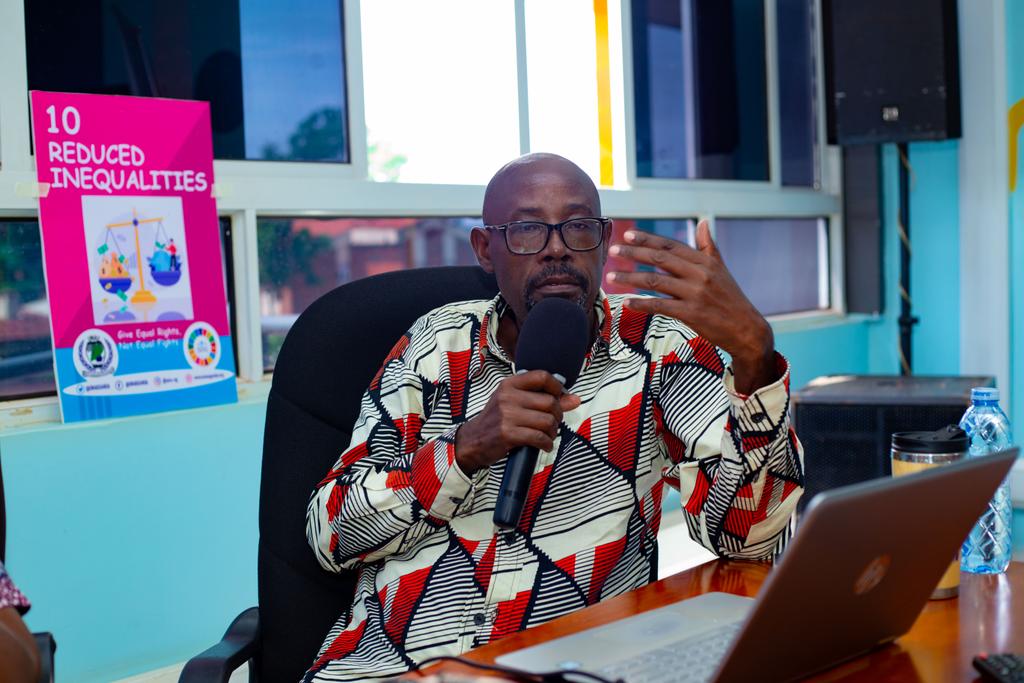
He added that the secondary schools, tertiary institution and universities are so critical in spreading the word about SDGs because the students come from some of these vulnerable setting hence they can come up with a new approach where students work with teachers to be able to reach more people in the communities and talk about the issues affecting them.
UNAU also wants them to conceive new programs by choosing the SDG each chapter or school would want to deal with and go down to the ground to implement activities that are meant to pursue and achieve some of the aspirations anticipated under the particular SDGs.

On how the country is faring in attainment of the SDG, Muwanguzi said that Uganda is not doing so well despite registering some progress since the previous review but there is still a lot of work to be done since the country is on track only 25% of the SDGs and yet they must be achieved by 2030.
However, he added that there is new momentum now from government, civil societies and the global community doing more to see that the remaining six years to 2030 substantial progress is achieved. Currently the world still has 6 years to have the 17 SDGs achieved which include: (1) No Poverty, (2) Zero Hunger, (3) Good Health and Well-being, (4) Quality Education, (5) Gender Equality, (6) Clean Water and Sanitation, (7) Affordable and Clean Energy, (8) Decent Work and Economic Growth, (9) Industry, Innovation and Infrastructure, (10) Reducing Inequality, (11) Sustainable Cities and Communities, (12) Responsible Consumption and Production, (13) Climate Action, (14) Life Below Water, (15) Life On Land, (16) Peace, Justice, and Strong Institutions, (17) Partnerships for the Goals
