
By Kabuye Ronald
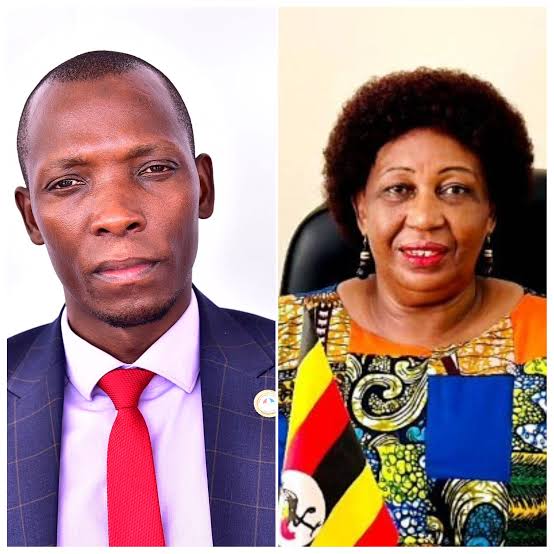
The Committee on Commissions, Statutory Authorities and State Enterprises (COSASE) chaired by Kyadondo East MP Muwada Nkunyingi tabled its report on Thursday following its Interaction with the Uganda Human Rights Commission (UHRC) over a month ago.

The Committee heard from the Commission about queries raised by the Auditor General in his report of the Financial Year ended 31st December 2025. These queries were raised in areas of procurement, assets registration and management, Strategic Plan implementation, Revenue Performance, Complaints/ Case management and inspection of places of detention.
The Committee is mandated by Rule 187 of the Rules of Procedure of Parliament to restrict the scope of its work to; examining the reports and audited accounts of statutory authorities, corporations, and public enterprises; consider the recommendations of the Auditor General relating to those audited accounts and to report back to the full Parliament on its findings.
A closer look at the report reveal a complete departure from the above stated limits to an overlay broad inquiry that usurped powers of other committees, abuse of authority and deliberate omission of clear evidence leading to unsupported/misleading conclusions.
For starters, the UHRC had what auditors categorize as “a clean report” with mostly “Unqualified opinions” and recommendations that were meant to improve and strengthen it.
However the COSASE proceedings and eventual report paints a picture of a dysfunctional institution. On reading the report, one of the senior UHRC staff who preferred to remain off record said: “Being an opposition-led committee, COSASE seems to have used this inquiry to settle political scores or score political goals best known to them as indicated.”
In this analysis we point out a number of findings/recommendations where the Committee fell short of what was expected from its inquiry.
Inquiry outside the reporting period
The Committee stretched its inquiry outside the stated Auditor Generals report when it inquired into funds received by personal assistants of the Chairperson like Ms. Doreen Nabatte for activities done in the Financial Year 2026/2027. During the auditing period (2024/2025), Ms. Nabatte had not yet joined the Commission but she ended up in the Committee testifying and eventually in the report. First, the Committee labeled the receipt of the said money as “wrongful” ignoring submissions from both the former Accounting Officer Ms. Margaret Lucy Ejang and the current one Mr. Byonabye Kamadi to the effect that it had been a general practice in the commission and all government MDAs before government developed the e-Cash system for officers charged with conducting activities, to receive funds for the said activities on their accounts. None of the two Accounting Officers disputed the fact that Ms. Nabatte or her predecessor conducted the activities for which the money was released and had fully accounted for it. But the Committee report goes ahead to recommend that they should be made to account and also refund all the monies.
Secondly, it focused on only the Chairperson’s office, leaving staff of Members of the Commission and other staff in the institution, thus raising queries as to whether this was a targeted inquiry as opposed to an institutional one.
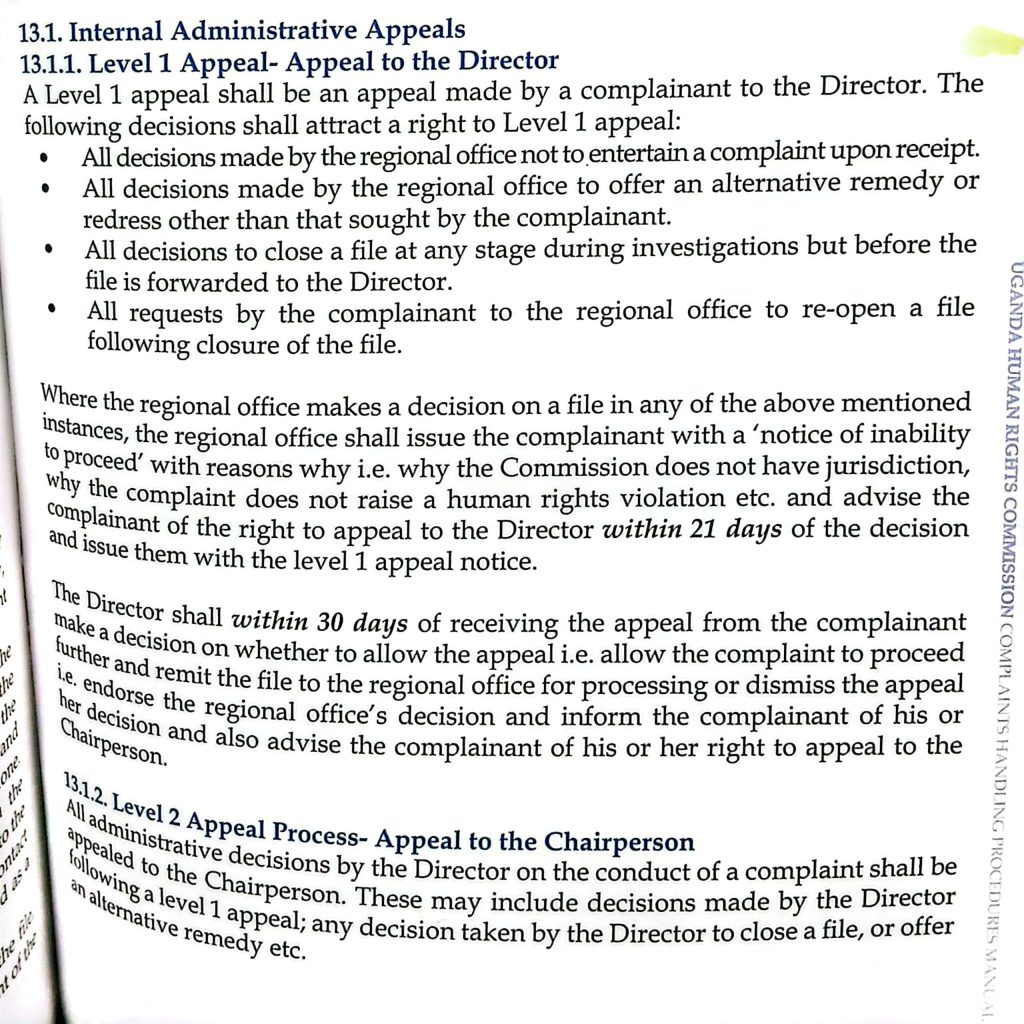
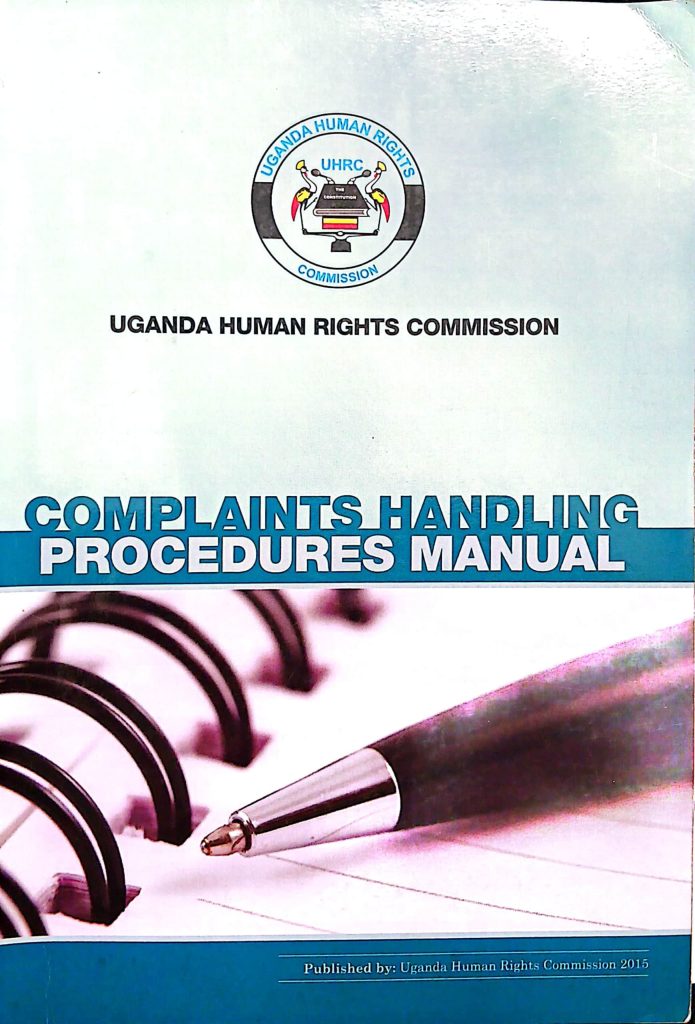
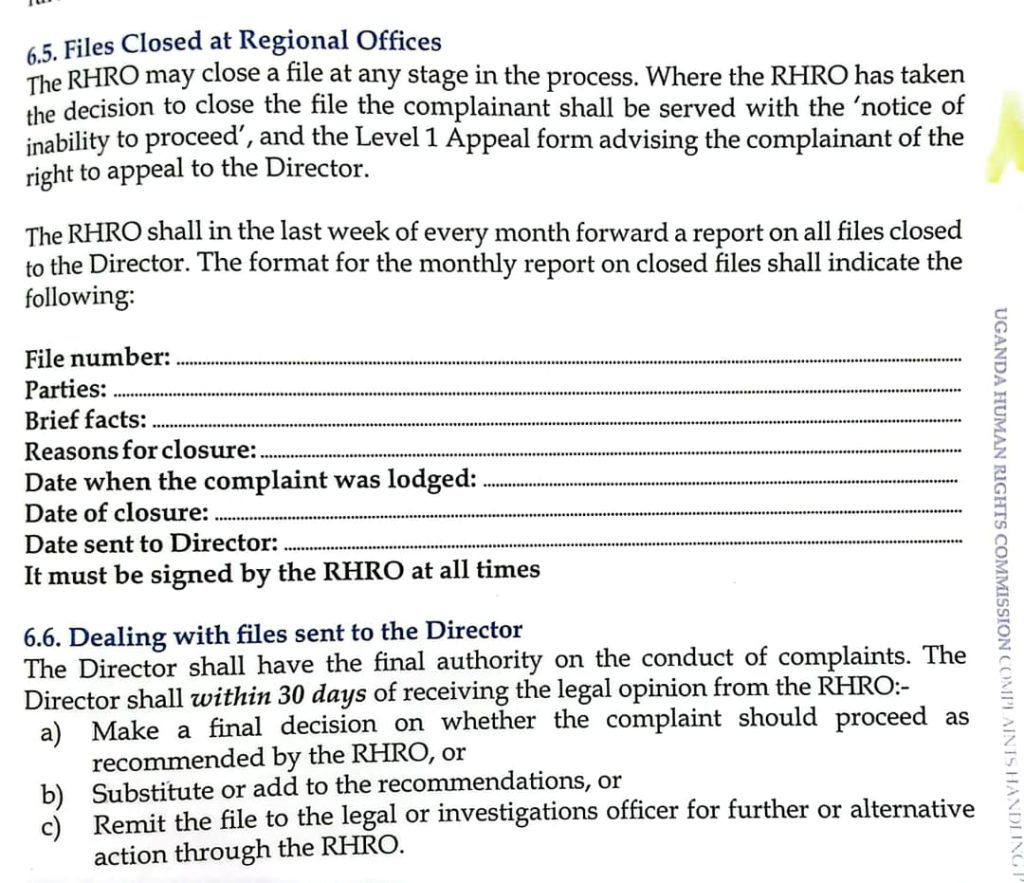
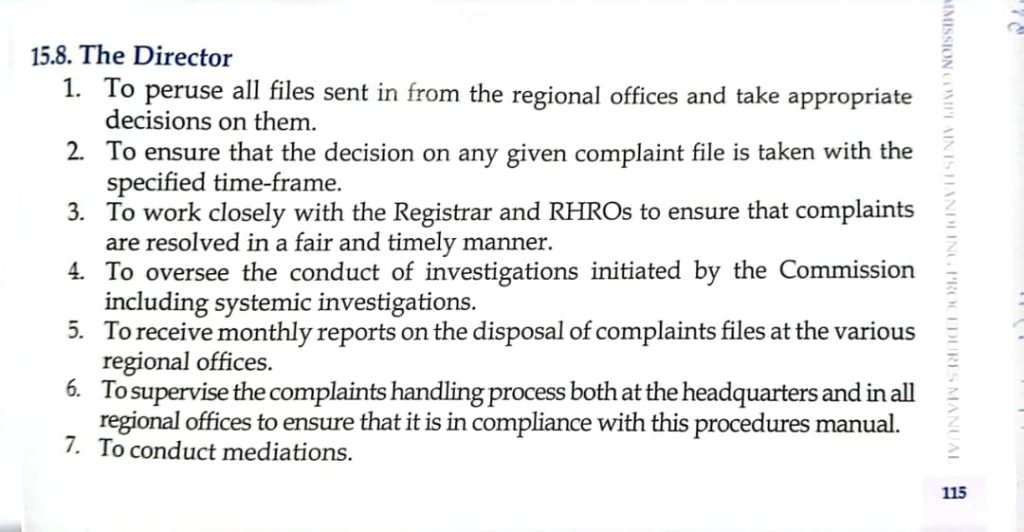
On the issue of closure of human rights complaints, the COSASE Report still targets Ms. Pauline Nansamba Mutumba, currently the Director Complaints, Investigation and Legal Services and former Personal Assistant to the Chairperson, heaping all the blame on her for all the complaints closed. The Committee selectively ignores the fact that the Commission has a Complaints Handling Procedure Manual put in place by the Commission of the late Chairman Hon. Med Kaggwa in 2015. Under Sections 6.5 and 6.6, the Manual empowers her and the Heads of the 12 UHRC Regional Offices to close complaints that do not meet the admissibility criteria. In fact, the Director Complaints also sits in an appellate capacity under sections 13.1.1 of the Manual, to review complaints recommended for closure or forwarded to the Tribunal for hearing by the Regional Offices and either agree to terminate them or allow them proceed to the tribunal for hearing.
The Manual also avails the complainant an opportunity to appeal to the Chairperson under Sections 13.1.2. Instead of finding issues with the said manual which came into force way back before Ms. Nansamba joined the Commission, the Committee focusses on the implementer who actually has no powers to review it.

Interference with Judicial Discretion
Without citing any single case that was irregularly closed, the COSASE report recommends that the Chairperson Hon. Mariam Wangadya be held personally liable for cases that were irregularly closed. It also recommended the reopening of such complaints. A part from the fact that such broad recommendation may turn out to be difficult to implement, it also interferes with judicial discretion of the Chairperson and the Commission’s independence as a whole contrary to Article 54 of the Constitution of the Republic of Uganda.
Even at appellate level in Courts of Judicature, judges sitting in appellate matters jealously guard themselves against making decisions that interfere with the trial judge’s discretion because the trial judge sits in a unique position to observe the live proceedings, weigh the context firsthand, and manage day-to-day courtroom matters. But in this case, the COSASE committee which interacted with the Chairperson and the Director for only two hours has recommended the re-opening of already closed complaints against those known legal principles. Both the Constitution and the UHRC Act mandates any person dissatisfied with the decision of the Commission to appeal to the High Court of Uganda. Instead of advising the dissatisfied parties to seek that existing remedy, the report seeks to have the Commission, which has for years been fighting for resources to reduce the existing case backlog, to again spend the meagre resources revisiting closed complaints.
Retirement in Public Interest
The report recommends the retirement of Members of the Commission and the Chairperson in “Public Interest to put an end to unjustified conflict.” Retirement in Public Interest can only occur due to; underperformance, incompetence, failure to perform duties, or violations of the service code. Under the Public Service Standing Orders Sections F-R, a Public Officer can only be retired “in Public Interest” due to “gross misconduct.” This very section goes ahead to define what constitutes gross misconduct and “nnjustified conflict” stated in the COSASE report is not among them. The COSASE report recommendation presupposes that there are criminal offence against the officers whom it seeks to retire in “Public Interest” yet it points out none.
Overstretched mandate
Apart from stretching beyond the period covered by the Auditor General, the Committee also overstretched its mandate from looking at the financial management of the Commission to delving into administrative issues which are a preserve of the Legal and Parliamentary Affairs Committee. Already, by the time this committee sat formally, the Legal and Parliamentary Affairs Committee had already sat and heard testimonies from Members of the Commission and the Chairperson. In fact, one of the MPs tried to guide the Chairman Muwada about deviating from the committee’s mandate under Rule 187 but he never took the guidance.
On a whole, the Committee was hostile to the Chairperson Hon. Mariam Wangadya to the extent of issuing an arrest warrant against her when she did not appear on its second sitting, instead of issuing criminal summons or a notice to-show-cause why an arrest warrant should not be issued against her for non-appearance. Luckily, she turned up herself the next day before the warrant could be effected.
Wangadya has been in the bad books of the MPs ever since she whistle-blew the grand corruption in the budgeting process during the 11th Parliament.
The report is slated to be debated by the whole house next week along with the report from the Legal and Parliamentary Affairs Committee.
By press time, it was not clear whether the Chairperson or any Member of the Commission was satisfied or dissatisfied with the report when contacted. Some preferred to comment after the report is debated in Parliament others just said “no comment” and hung up.
