
By Kabuye Ronald
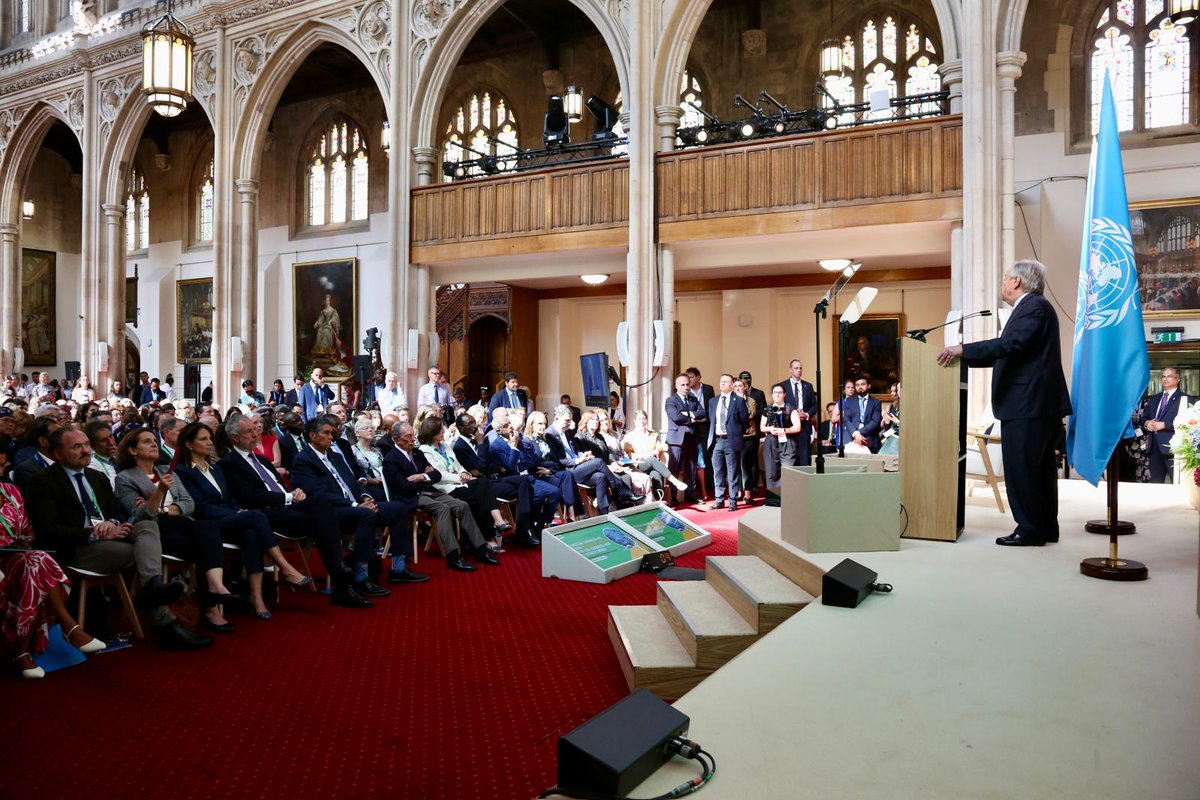
The United Nations Secretary-General António Guterres delivered a stark warning on Tuesday that the world is confronting a “Tale of Two Crises” driven by fossil fuel dependence, urging governments, businesses and financial institutions to accelerate the transition to renewable energy before climate and economic shocks spiral further out of control.
Addressing leaders, policymakers and climate advocates at London Climate Action Week, Guterres said the climate emergency and a worsening global energy crisis share a common cause: fossil fuels.
“Crisis brings clarity,” he told delegates. “Our world is facing a Tale of Two Crises — a climate crisis pushing us deeper toward higher temperatures and catastrophic tipping points, and an energy crisis exposing the folly of a world hooked on hydrocarbons.”
The Secretary-General warned that climate change is advancing at an alarming pace, noting that the world has experienced its eleven hottest years on record and that average global temperatures are expected to exceed the critical 1.5°C threshold established under the Paris Agreement.
“Every fraction of a degree matters. Every moment counts,” he said.

Citing a newly released report from the United Nations Scientific Advisory Board, Guterres warned that dangerous planetary tipping points are approaching faster than many scientists previously believed.
Among the risks highlighted were the collapse of coral reef ecosystems, accelerating ice-sheet loss in Greenland and Antarctica, disruptions to major ocean circulation systems, and the potential transformation of parts of the Amazon rainforest into savanna-like landscapes.
“The Earth’s tipping points are like objects in a car mirror,” he said. “They are far closer than they appear.”
Guterres also pointed to the economic fallout from conflict in the Middle East, describing the resulting energy shock as one of the most severe in modern history.
According to the International Energy Agency, the disruption rivals the oil crises of the 1970s combined with the market turmoil following Russia’s invasion of Ukraine.
For developing countries, he said, the consequences extend beyond energy prices.
“This is not just an energy crisis. It is a debt shock, a food shock and a development shock,” he warned.
Despite the challenges, Guterres emphasized that the world now has an unprecedented opportunity to break free from fossil fuel dependence.
He pointed to dramatic declines in renewable energy costs over the past decade, noting that solar power costs have fallen by nearly 90 percent, while battery storage costs have dropped by 95 percent.
Last year, wind and solar energy accounted for all net growth in global electricity demand, while renewable energy investments attracted nearly twice as much capital as fossil fuels.
“There are no embargoes on sunlight and no blockades on the wind,” Guterres declared.
He argued that energy security can no longer be built on fossil fuels and that renewable energy has become the cornerstone of economic resilience and national security.
A centerpiece of the speech was the launch of a new global Call to Action on Methane, targeting emissions from waste, agriculture and the fossil fuel industry.
Methane is responsible for roughly one-third of global warming and is approximately 80 times more potent than carbon dioxide over a short-term period.
Guterres criticized the oil and gas sector for failing to address methane leaks despite the availability of cost-effective technologies.
“Voluntary action is no longer enough,” he said. “Methane pollution must be next.”
He called on governments and industry leaders worldwide to establish near-zero methane emissions across the oil and gas value chain.
The Secretary-General also turned his attention to the rapid growth of artificial intelligence, warning that data centers powering AI systems are becoming major consumers of electricity, water and land.
To address the issue, he announced a proposed AI Environmental Transparency Initiative, calling on major technology companies to publicly disclose the environmental footprint of their operations and commit to powering all data centers with renewable energy by 2030.
“No more hidden costs. No more shifting the burden onto those least able to bear it,” he said.
Guterres outlined a seven-point roadmap for tackling the intertwined climate and energy crises:
- Accelerate emissions reductions and limit temperature overshoot beyond 1.5°C.
- Address energy security without expanding fossil fuel production.
- Increase transparency and sustainability in AI infrastructure.
- Ensure a just transition for workers, communities and developing economies.
- Expand adaptation and resilience measures against climate impacts.
- Mobilize climate finance at greater scale and affordability.
- Defend scientific integrity and combat climate misinformation.
He also urged governments to impose windfall taxes on fossil fuel companies, noting that the world’s eight largest oil and gas firms earned an additional $6.5 billion during the first quarter of 2026 amid rising energy prices.
“These are windfall gains born of pain, instability and dependence,” he said.
The UN chief stressed that developing countries, particularly in Africa, continue to face barriers in accessing clean-energy investment despite possessing abundant renewable resources.
Africa, he noted, holds 60 percent of the world’s best solar resources but receives only 2 percent of global clean-energy investment.
“This is unjust and a lost opportunity for Africa and the world,” he said.
Closing his speech, Guterres returned to the Dickensian theme that framed his address, describing the current period as both “the best of times and the worst of times” for global climate action.
While climate impacts are intensifying and fossil fuel dependence continues to threaten economic stability, he said the rapid expansion of renewable energy presents a historic opportunity.
“We can finally turn the page on fossil fuels and write a future powered by renewables and rooted in climate justice,” Guterres said.
“This is our moment of choice. Our moment of truth. Our moment of opportunity. Let’s seize it.”
