
By Jumah Kakomo
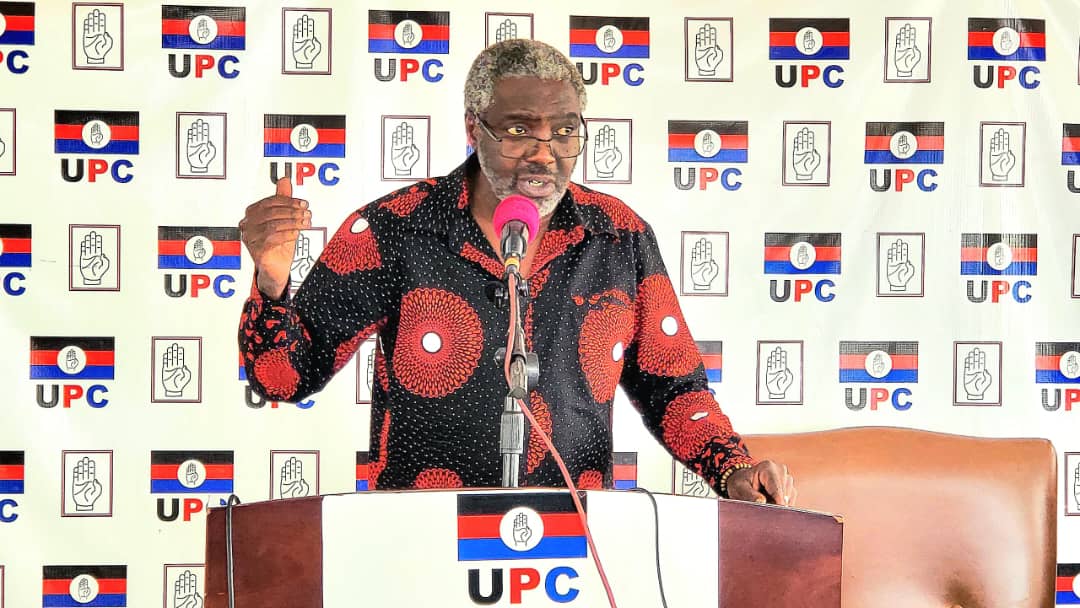
Uganda People’s Congress (UPC) president Jimmy James Michael Akena has challenged the government to overhaul the country’s education system, warning that Uganda cannot build its future by measuring education mainly through examinations and years spent in school.
As learners return for the third term ahead of the Primary Leaving Examination (PLE), Uganda Certificate of Education (UCE) and Uganda Advanced Certificate of Education (UACE), Mr Akena said the examination season should prompt a bigger national question: What is Uganda preparing its children for, and what kind of country are they being prepared to build?

He said Uganda’s greatest national asset is its people and that development must therefore begin with producing citizens who are healthy, educated, capable, skilled and productive.
“We have been undertaking a detailed examination of our education system, just as we have been doing with health. That work is continuing, but the direction is becoming increasingly clear,” Mr Akena said.
Two million children affected
Mr Akena said the education crisis begins long before a child enters Primary One, pointing to childhood nutrition as a critical foundation for learning.
Citing the 2022 Uganda Demographic and Health Survey, he said about 26 per cent of children under five were stunted. Applied to the current population of young children, he said, this represents about 1.9 million children—roughly two million Ugandans.
The regional disparities, he said, are even more striking

Stunting stood at about 44 per cent in Karamoja, 42 per cent in Kigezi and 39 per cent in Tooro, according to the figures he cited.
Mr Akena said the figures show that malnutrition is not simply a question of food availability.
“Karamoja faces severe food-security challenges. But Kigezi and Tooro remind us that even productive agricultural areas can have very high levels of childhood malnutrition,” he said.
He attributed child development outcomes to several factors, including diet and dietary diversity, maternal nutrition, infant feeding, disease, sanitation and household practices.
He called for greater attention to maternal nutrition during pregnancy, low birth weight and the first 1,000 days of life, followed by closer monitoring of child development through the first two years and up to age five.
“By the time that child arrives at P1, considerable human development has already taken place or has already been lost,” he said.
Public schools face questions
Mr Akena also questioned what happens to children as they progress through Uganda’s education system.
He said Uganda had about 11.8 million primary-school learners in 2025, of whom about 9.1 million were in public schools and 2.7 million in private schools.
Government, therefore, carries the bulk of primary education.
But Mr Akena pointed to examination figures showing an increasing proportion of candidates outside the universal government programmes as learners move up the education ladder.
At the 2025 PLE, he said, 36.2 per cent of candidates were non-UPE. At UCE, about 64.2 per cent were non-USE, while at UACE, about 74.6 per cent were outside UPOLET.
He cautioned that the figures should be interpreted carefully because the examinations do not represent the same cohort and UPE, USE and UPOLET are financing classifications rather than precise measures of public and private school ownership.
But he said the trend warrants investigation.
“Who is transferring? Who is dropping out? Who is moving from public to private education? Who is successfully progressing?” he asked.
He also questioned how much parents are paying to keep their children in school.
Rather than condemning private education, Mr Akena said Uganda should ask why parents of modest means are making significant sacrifices to pay for education and what can be done to restore their confidence in public schools.
‘A school without teachers is not education capacity’
Mr Akena said Uganda’s education challenge extends beyond buildings and infrastructure.
Drawing a parallel with staffing shortages in the health sector, he said a school without enough teachers cannot provide effective education.
“A hospital without health workers is not effective health capacity. A school without sufficient teachers is not effective education capacity,” he said.
He cited figures showing that government primary schools average about 61 pupils per teacher and 79 pupils per classroom.
But he said national averages conceal the realities facing individual schools.
He called for school-by-school assessments to establish teacher requirements and actual staffing, as well as the condition of teachers’ accommodation, water, toilets, electricity, classrooms, desks and textbooks.
Laboratories, workshops, libraries, computer laboratories and sporting facilities should also be assessed, including whether the available equipment actually works.
The central question, he said, should ultimately be what children are learning.
Against the backdrop of renewed public debate over corruption and the use of public resources, Mr Akena urged Ugandans to inspect the institutions where the country claims to be developing its greatest national asset.
“Look at the school. Look at the classroom. Look at the toilet. Look at the water supply. Look at the teacher’s accommodation. Look at the laboratory, workshop and library,” he said.
‘Five years in school must mean something’
Mr Akena said Uganda should shift from measuring education by years spent in school to measuring what children can actually do.
One proposal emerging from his party’s work is a P5 Minimum Foundational Capability Guarantee.
The proposal, he stressed, would not make Primary Five an exit point. Children should continue their education and progress as far as their abilities allow.
But by P5, he said, every child should be able to read with understanding, communicate an idea, perform practical arithmetic, understand money and measurement, reason through an elementary problem and begin learning independently.
“P5 must be a guarantee, not an exit point,” he said.
Mr Akena said education should also expose children to more than examination subjects, arguing that Uganda must ultimately build an education system focused on developing citizens capable of contributing to the country’s social and economic development.
